IAP vs Government Vaccine Schedule 2025: One-Minute Cheat-Sheet—Which ‘Optional’ Shots Really Matter?
- Dr Ajay Gupta

- Jul 18, 2025
- 4 min read
Updated: Jul 30, 2025
Introduction
If you’re a parent in India, you’ve probably stared at your child’s vaccination card and wondered:
“Why are there so many vaccines listed by my pediatrician that aren’t on the government schedule? Are they really needed—or just ‘optional’?”
You’re not alone.
Every parent wants the best for their child’s health, but the difference between the IAP (Indian Academy of Pediatrics) Schedule and the Government (UIP/NIP) Schedule often creates confusion.
So, let’s simplify this together. In the next few minutes, you’ll learn exactly which vaccines are mandatory, which are optional, and why some “extra” shots could save you thousands in treatment costs later.

IAP vs NIP: What’s the Difference?
NIP (National Immunisation Programme) is run by the government.
It covers free vaccines for life-threatening diseases like polio, measles, and hepatitis B.
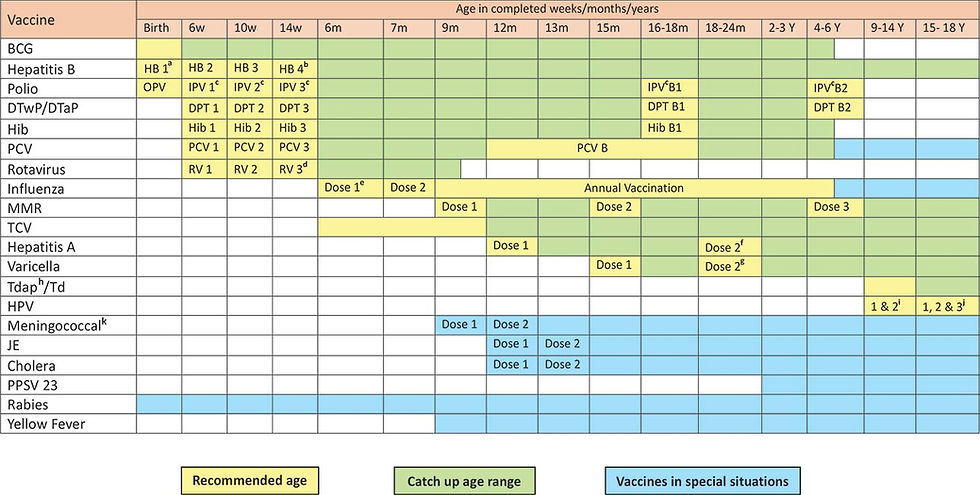
IAP (Indian Academy of Pediatrics) Schedule is a more detailed, updated schedule recommended by child specialists.
It includes additional vaccines like PCV (pneumonia), HPV, and Rotavirus to protect against diseases that may not be life-threatening but can cause serious complications or high hospital bills.
💡 Want to understand how vaccines prevent common family infections? 👉 Read our Family Flu Shield guide
Think of NIP as the basic safety net, and IAP as the gold-standard shield.
🛡️ 2025 Vaccine Cheat‑Sheet: Govt (UIP/NIP) vs IAP Schedule
India’s Universal Immunization Programme (UIP)—also called National Immunisation Programme (NIP)—provides free vaccines against 12 key diseases to children and pregnant women at government clinics. (Source: MoHFW)
Vaccines provided by Govt (UIP/NIP)
At birth: BCG, OPV-0, Hepatitis B (birth dose)
6, 10, 14 weeks: Oral Polio Vaccine (OPV 1–3), Pentavalent (DPT + Hep B + Hib), fIPV (fractional IPV), Rotavirus, Pneumococcal Conjugate Vaccine (PCV in select states)
9–12 months: Measles-Rubella (MR‑1), PCV booster, Japanese Encephalitis (JE) in endemic zones
16–24 months: MR‑2, JE‑2, DPT booster, OPV booster
5–6 years: DPT booster‑2
10 & 16 years: Td booster (tetanus-diphtheria)
Pregnant women: Td‑1 and Td‑2 during or after every pregnancy
👉 UIP also includes Rotavirus and PCV in phased rollout; JE vaccine is given only in endemic districts.
What the IAP Recommends Beyond UIP
Disease / Vaccine | UIP (Free) | IAP (Recommended) |
Polio, BCG, Hep B, MR‑2 | ✅ | ✅ |
Pentavalent | ✅ | ✅ |
fIPV | ✅ | ✅ |
Rotavirus, PCV | ✅ (in phases) | ✅ Universal |
JE | ✅ (endemic zones) | ✅ Optional nationally |
Varicella (Chickenpox) | ❌ | ✅ |
HPV (Cervical cancer) | ❌ | ✅ (both girls & boys) |
Influenza (annual flu) | ❌ | ✅ |
Typhoid Conjugate | ❌ | ✅ |
Tdap (Adolescent booster) | ❌ | ✅ Ages 10–12 years |
9mo & 12 mo (2 doses) or at 2 years (1 dose): MCV
💡 Want to know why HPV vaccine is important for boys too? 👉 Read our HPV Vaccine for Boys in India: 4 Myths Every Parent Must Stop Believing
Why These Optional Vaccines Matter
Rotavirus vaccine → Prevents severe diarrhea, which sends 2 lakh Indian kids to hospitals every year.
Pneumococcal (PCV) → Stops pneumonia and ear infections, cutting hospital admissions by almost 70%.
HPV vaccine (for boys & girls) → Prevents future cancers.
Chickenpox vaccine → Avoids painful rashes and scars.
Influenza vaccine → Protects your whole household, especially grandparents.
Typhoid vaccine → Prevents typhoid fever, a potentially serious bacterial infection.
HAV vaccine → Prevents prevents hepatitis A, a contagious liver infection.
MCV vaccine → Prevents serious infections like meningitis and bloodstream infections
These vaccines aren’t luxury extras—they prevent illnesses that disrupt life, cost money, and sometimes cause long-term damage.
What About Costs?
Government vaccines: Free in public health centers.
Optional vaccines (private): ₹500–₹4,000 per dose depending on the vaccine. Find the tentative costs of all IAP-recommended vaccines here.
💡 A hospital admission for pneumonia or rotavirus diarrhea can cost ₹15,000–₹40,000—far more than the vaccine price.
Want a cost guide for key vaccines? 👉 Check our Chickenpox Vaccine Price Guide 2025
What Should Parents Do?
Here’s a simple action plan:
Follow the mandatory NIP schedule without fail.
Discuss optional vaccines with your pediatrician. Ask about your child’s risk, daycare exposure, and local outbreaks. Click here and send us your query for a quick answer from Dr Ajay Gupta.
Plan ahead for costs. Bundle multiple vaccines during the same visit to save time and clinic charges.
Keep a digital record. Take a photo of the vaccine card so you never lose track.
FAQs for Parents
(With internal links for deeper reading)
Why are some vaccines free and others paid? Govt covers high-risk diseases; IAP adds vaccines to prevent extra illnesses.
Can I mix NIP & IAP schedules? Yes. Your doctor can merge both safely.
My child missed an optional vaccine—can we catch up later? Yes! Here’s our catch-up vaccine guide.
Are optional vaccines safe? Yes. All are WHO & IAP-approved.
Can two vaccines be given on the same day? Absolutely—different injection sites are used.
Is HPV vaccine only for girls? No. It protects boys from cancers too.
Should healthy kids get flu shots? Yes. Annual flu shots also protect family elders.
Do optional vaccines cause fever? Mild fever/soreness is normal, serious events are very rare.
Are optional vaccines compulsory for school admission? Some schools prefer a complete vaccine record.
Where should I get them? Pediatric clinics following IAP schedules are best.
✅ Conclusion
The UIP/NIP schedule saves lives—never skip it. But the IAP schedule goes further, protecting kids from everyday infections that still cause hospitalisations, stress, and hidden costs.
Your child’s health isn’t optional. Speak to your pediatrician about vaccines beyond the basics.
Want a personalized vaccine plan for your child? 👉 Send us a WhatsApp Message


Very informative 👍Thank you so much